Primary cause of wind, pressure gradient, Coriolis force, gradient wind (050.02.02.01)
Define the term ‘horizontal pressure gradient’ (050.02.02.01.01).
The winds at any level are driven by the pressure pattern at that level, as air will try to flow from areas of high pressure to areas of low pressure. The rate at which the atmospheric pressure changes across a horizontal distance (along the Earth’s surface) is called horizontal pressure gradient.
In simpler terms, it describes how quickly air pressure increases or decreases from one place to another on the same level.
Explain how the pressure gradient force acts in relation to the pressure gradient (050.02.02.01.02).
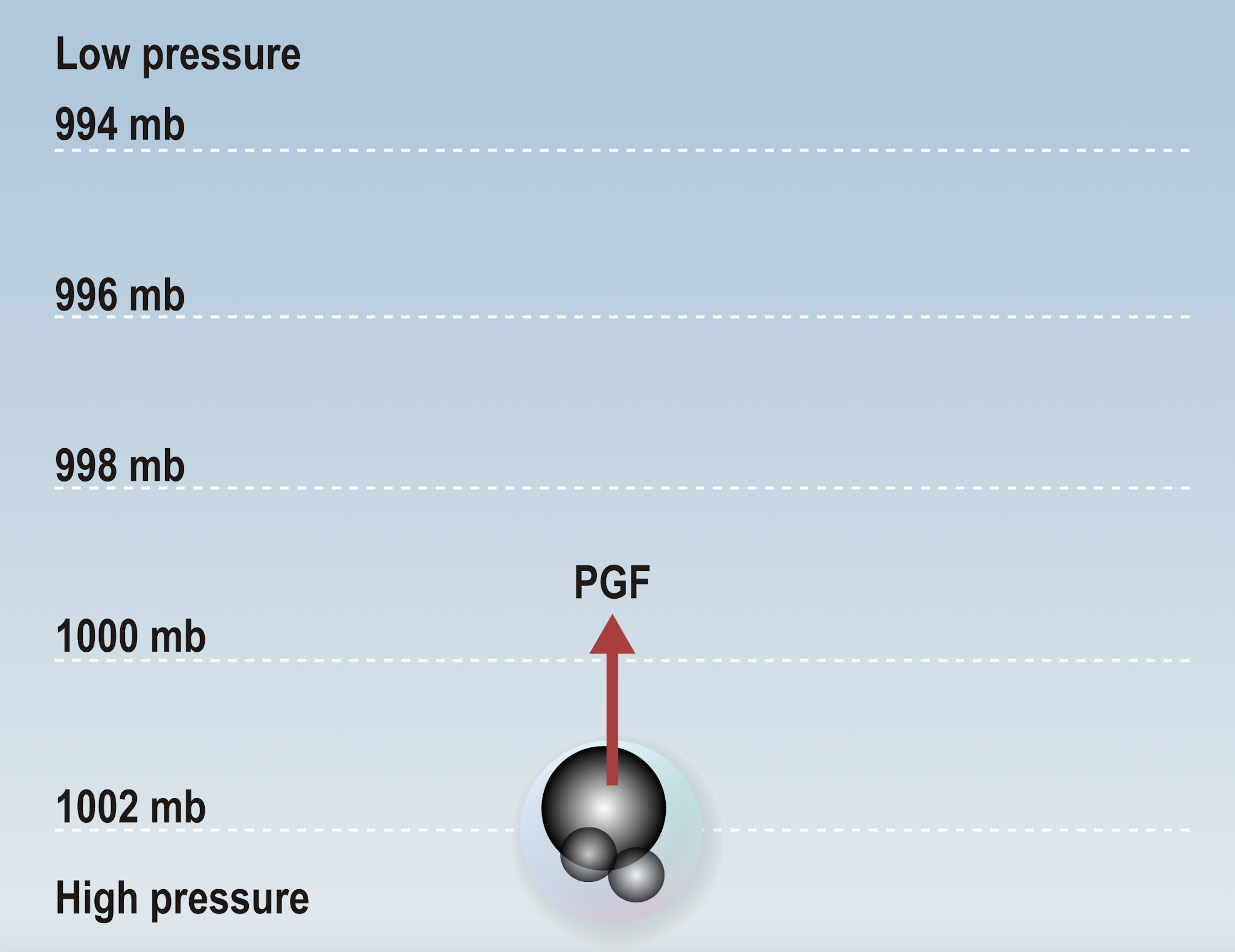
The force that tries to move air from high pressure to low pressure is called the Pressure Gradient Force (PGF). The pressure gradient force always acts perpendicular to the isobars (lines of equal pressure) and from high pressure toward low pressure.
The pressure gradient force acts at right angles to the isobars. It is stronger when the isobars are closer together.
The first thing the air will do when acted on by the pressure gradient force is to start to move across the (straight) isobars from high to low pressure.
Explain how the Coriolis force acts in relation to the wind (050.02.02.01.03).
Explain the development of the geostrophic wind (050.02.02.01.04).
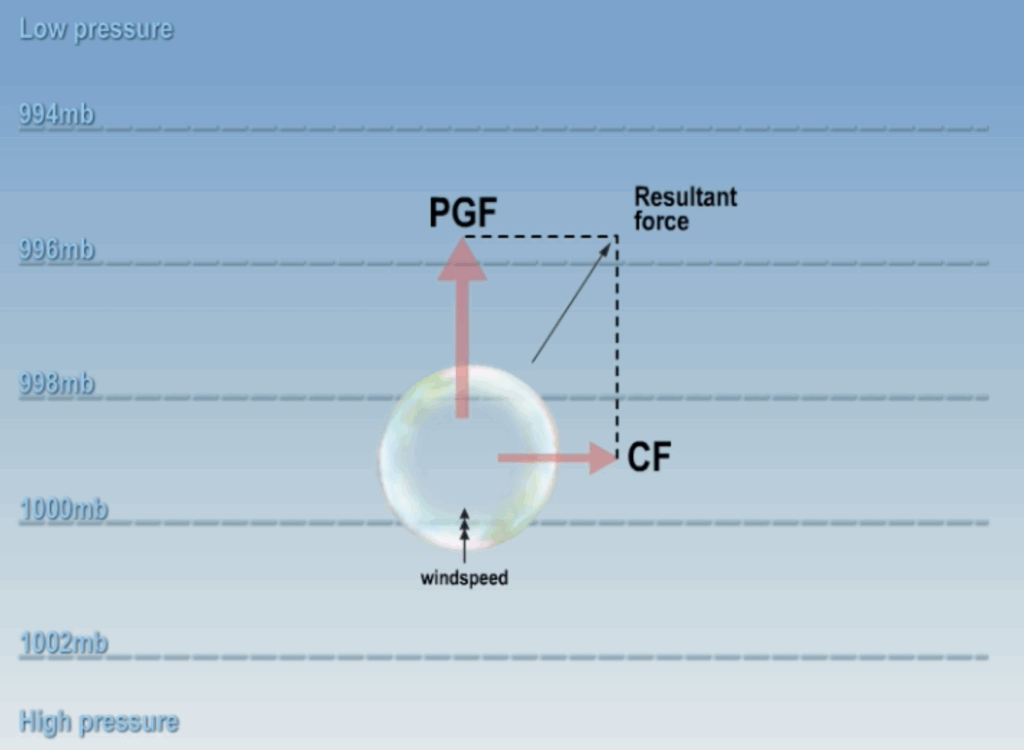
As air starts to move a second force, the Coriolis force, (due to the rotation of the Earth) starts to act on it (perpendicular to the direction of movement of the air).
The Coriolis force in formula:
CF = 2 * ω * ρ * V * sin (Lat)
(ω = earth’s rotation speed, ρ = air density, V = wind speed)
The sum of the pressure gradient force and the Coriolis force makes the air accelerate and turn to the right in the northern hemisphere (opposite in the southern hemisphere).
In the northern hemisphere the Coriolis force makes the moving air turn to the right.
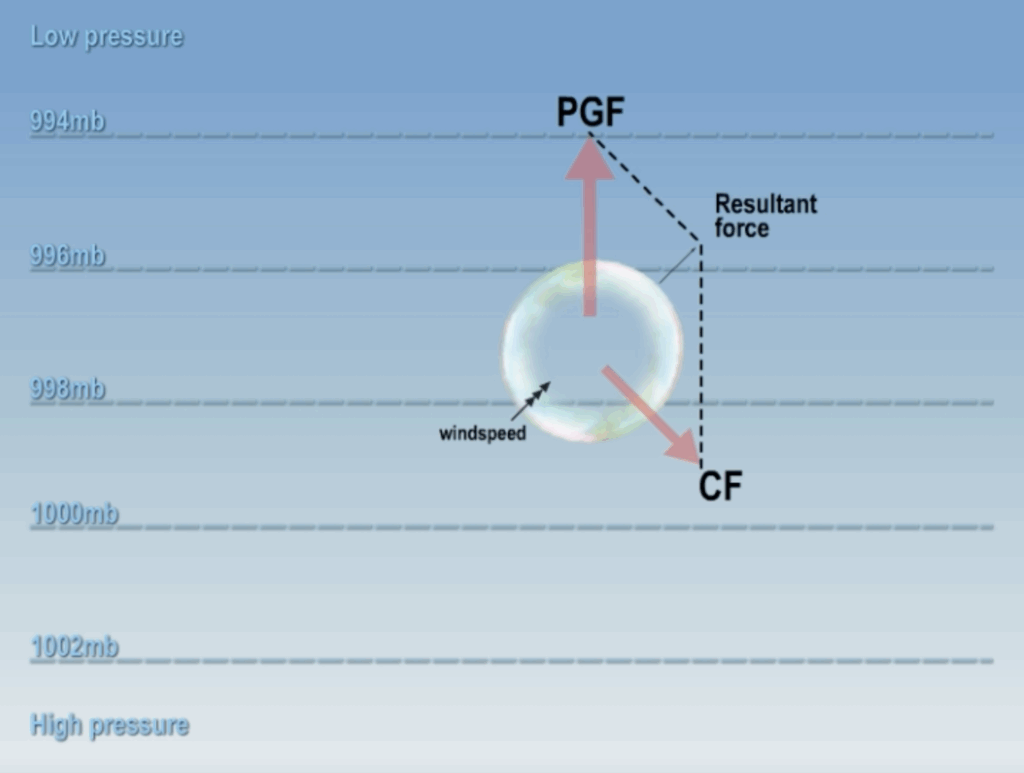
After a time, the air will have turned an wil have a higher speed, but it will still be acted on by the two forces. The pressure gradient force will have the same size, but the Coriolis force will be larger because the wind speed is higher.
As the process continues, the resultant force keeps on turning the air to the right, and although it is still increasing its speed, the rate of acceleration is reducing because the resultant force is getting smaller.
Eventually an equilibrium will be reached, the pressure gradient force and the Coriolis force are equal in magnitude and directly opposing each other. A steady state of air flowing parallel to the isobars, called the Geostrophic wind. In this steady state: PGF = CF = 2 * ω * ρ * V * sin (Lat)
Geostrophic wind, air flowing parallel along straight isobars.
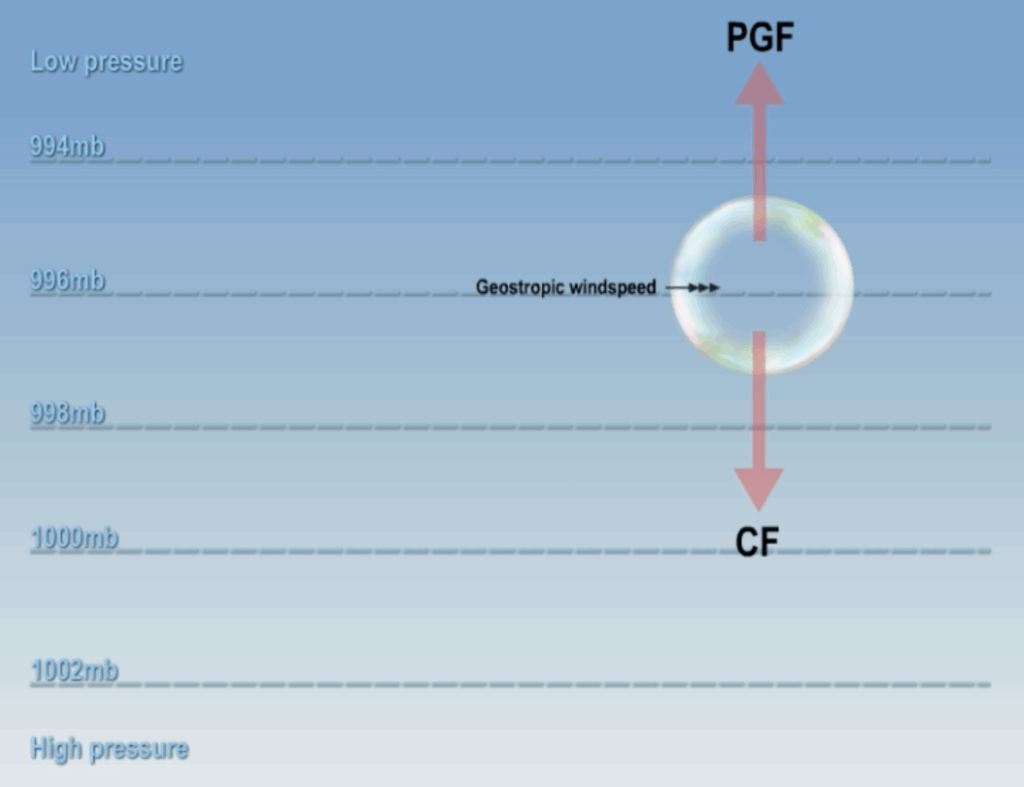
Indicate how the geostrophic wind flows in relation to the isobars/isohypses in the northern and in the southern hemisphere (050.02.02.01.05).
Buys Ballot’s law:
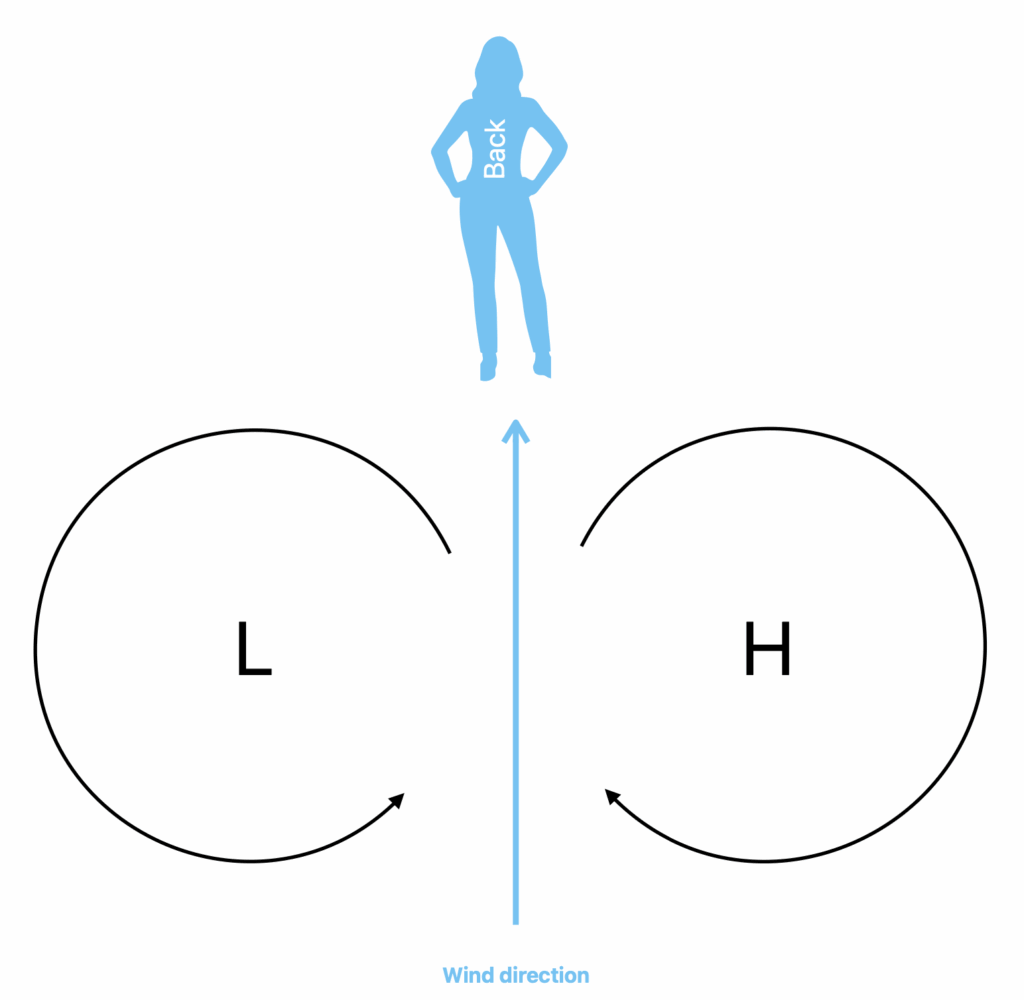
Because of the way the Coriolis force works, it means that, if you stand with your back to the wind in the northern hemisphere, low pressure is on your left. Furthermore, the result is that winds circulate anti-clockwise around a low-pressure area, and clockwise around a high-pressure area.
With the wind in your back, in the northern hemisphere, low pressure is on your left.
Winds go anti-clockwise around a low, in the northern hemisphere.
Winds go clockwise around a high, in the northern hemisphere.
Analyse the effect of changing latitude on the geostrophic wind speed (050.02.02.01.06).
The Coriolis force is zero at the equator and initially very low nearby. Between 15°N and 15°S the Coriolis force is so weak, that it takes so long for the Coriolis force to have effect, that pure geostrophic winds are rarely formed.
At higher latitudes the Coriolis force has a more significant effect. Based on the equation: PGF = Isobar spacing = CF = 2 * ω * ρ * V * sin (latitude), we can derive that if the isobar spacing is a constant on the left hand side of the equation, and we assume that the earth’s rotation (ω) and the density (ρ) are also constant, than it leaves us with only two variables, the latitude and wind speed (V).
So, if the latitude is low (near the equator), then sin(latitude) will also be low. This means that V must be high.
Low latitudes, higher wind speeds (for a given pressure gradient force).
Additionally, at higher altitudes the density will be lower. So, for the same latitude, and assuming that the PGF is constant we can derive from the formula that the wind speed will increase with altitude as the density decreases.
High altitudes, higher wind speeds (for a given pressure gradient force).
Explain the gradient wind effect and indicate how the gradient wind differs from the geostrophic wind in cyclonic and anticyclonic circulation (050.02.02.01.07).
In practice pressure patterns with straight and parallel isobars are hard to find. More common are curved isobars.
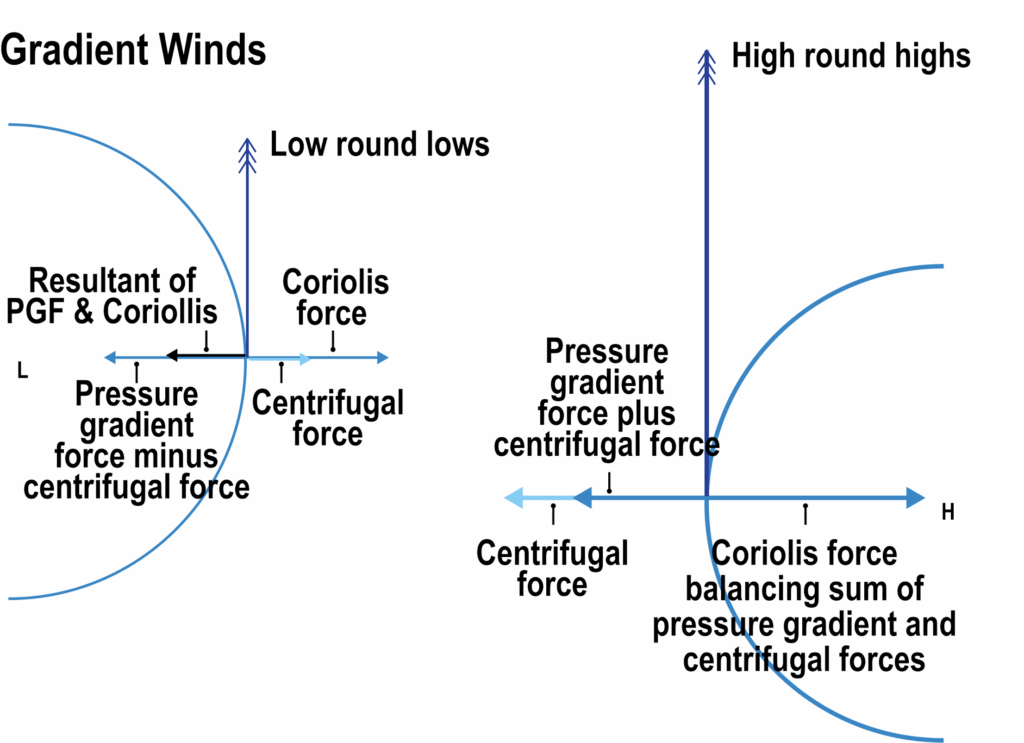
The free flow wind will still move parallel to curved isobars, but an additional force is introduced – centrifugal force – which acts from the centre of the rotation outwards.
The gradient wind is the geostrophic wind modified by centrifugal force.
The gradient wind is “high round a high”, because the centrifugal force acts in the same direction as the pressure gradient force (and strengthens it).
The gradient wind is “low round a low”, because the centrifugal force opposes the pressure gradient force (and weakens it).