Composition, extent, vertical division (050.01.01)
Structure of the atmosphere (050.01.01.01)
Describe the vertical division of the atmosphere up to flight level (FL) 650, based on the temperature variations with height (050.01.01.01.01).
List the different layers and their main qualitative characteristics up to FL 650 (050.01.01.01.02).
The envelope of gas surrounding the Earth changes from the ground up. Five distinct layers have been identified using:
- thermal characteristics (temperature change);
- chemical composition;
- movement, and
- density.
Each of the layers are bounded by “pauses”, where the greatest changes in thermal characteristics, chemical composition, movement and density occur.
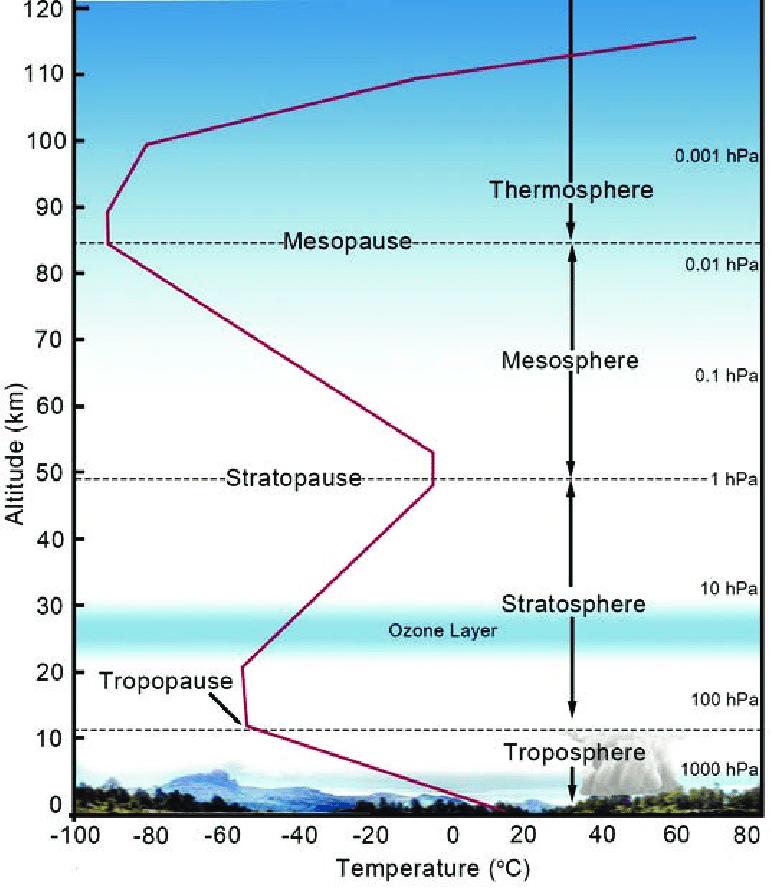
Based on temperature variation with height, the atmosphere up to FL 650 (≈ 65,000 ft / 20 km) is divided as follows:
1. Troposphere
- Surface to ~FL 360
- ~11 km at mid-latitudes
- Lower at the poles (~FL 280), higher at the equator (~FL 550)
- Temperature trend:
- Decreases with height at an average lapse rate of ≈ 6.5 °C per km (≈ 2 °C per 1,000 ft)
- Key features:
- Contains almost all weather
- Strong vertical mixing and turbulence
- Most commercial aviation operates in the upper troposphere
2. Tropopause
- Altitude:
- Around FL 360 (variable with latitude and season)
- Temperature trend:
- Nearly constant with height (isothermal layer)
- Key features:
- Marks the boundary between troposphere and stratosphere
- Acts as a “cap” limiting vertical weather development
- Temperature typically around –56.5 °C (ICAO standard)
3. Stratosphere (Lower Stratosphere)
- From the tropopause to above FL 650
- Temperature trend:
- Increases with height (temperature inversion)
- Key features:
- Very stable air, little vertical motion
- Minimal weather
- Ozone absorption of UV radiation causes warming with height
- Supersonic and high-altitude flight may occur here
Summary (Temperature-Based Division up to FL 650)
| Layer | Approx. Altitude | Temperature with Height |
|---|---|---|
| Troposphere | Surface → FL 360 | Decreases |
| Tropopause | ~FL 360 | Constant |
| Stratosphere | FL 360 → FL 650+ | Increases |
Troposphere (050.01.01.02)
Describe the troposphere (050.01.01.02.01).
Describe the main characteristics of the tropopause (050.01.01.02.02).
The troposphere is the lowest layer of the atmosphere, extending from the Earth’s surface up to the tropopause.
Extend
- Average height: ~11 km (36,000 ft)
- Varies with latitude:
- Equator: ~16–18 km
Due to higher temperatures at the equator, air is rising higher up. - Mid-latitudes: ~11 km
- Poles: ~8–9 km
- Equator: ~16–18 km
- Height at mid-latitudes changes with season (higher in summer, lower in winter),
as the tropopause is higher where the mean troposphere temperature is higher. As the temperatures at the poles and the tropics remain relative constant throughout the year, there will be no significant changes at height at these latitudes.
Temperature
- Decreases with height
- Average lapse rate: 6.5°C per 1,000 m (1.98°C per 1,000 ft)
- Temperature decrease stops at the tropopause
Pressure and density
- Pressure and air density decrease rapidly with altitude
- Contains about 75% of the total mass of the atmosphere
- 50% in the bottom 18.000ft (5.5 km);
- 25% in the remaining 5.5 km;
- Contains about 90% of atmospheric water vapour
This is one of the reasons why all of the significant weather (clouds and precipitation) occurs in the troposphere.
Describe the proportions of the most important gases in the air in the troposphere (050.01.01.02.03).
In the lower atmosphere, the relative concentration of gases is more or less constant:
| Name | Symbol | Volume (%) |
|---|---|---|
| Nitrogen | N2 | 78.084 % |
| Oxygen | O2 | 20.946 % |
| Argon | Ar | 0.9340 % |
| Carbon Dioxide | CO2 | 0.0397 % |
| Neon | Ne | 0.001818 % |
| Helium | He | 0.000524 % |
| Methane | CH4 | 0.000179 % |
Remember that 78% of the atmosphere in the troposphere exists of Nitrogen and 21% exists of Oxygen.
Describe the variations of the FL and temperature of the tropopause from the poles to the equator (050.01.01.02.04).
Describe the breaks in the tropopause along the boundaries of the main air masses (050.01.01.02.05).
The tropopause marks the limit of the vertical movement in the air, and therefore the upper limit of significant water. Although the average height is 11 km, the height at which the tropopause starts is higher at the equator and lower at the poles. In contrast, the temperature of the tropopause at the equator is colder than average, and warmer than average at the poles.
This is caused by stronger convection (rising air, by solar heating) at the equator, diverging at the tropopause towards mid-latitudes, and sinking. Vertical movement at the poles is weaker, therefore the tropopause starts at a lower height.
| Latitude | Height | Temperature |
|---|---|---|
| Poles | 26,000 ft (8km) | -45°Ç |
| Mid-latitudes | 36,090 ft (11km) | -56°C |
| Equator | 52,500 ft (16km) | -75°C |
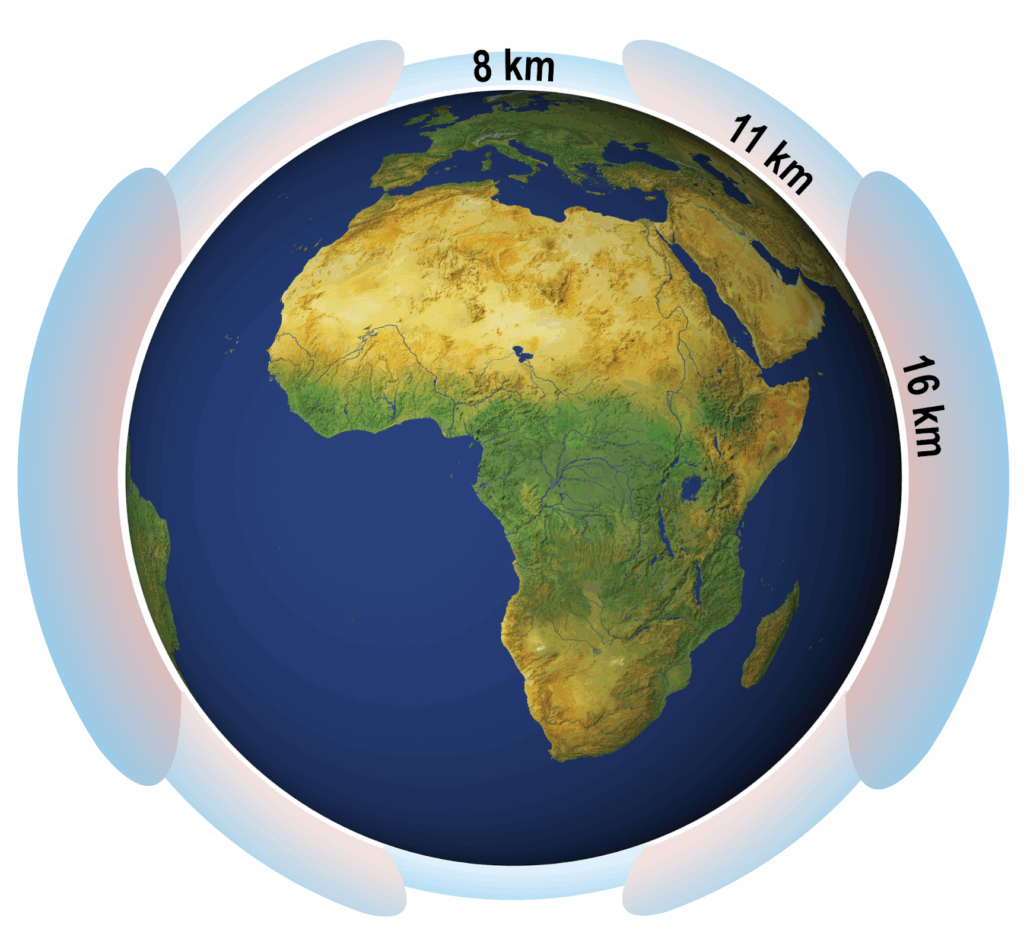
The breaks in the tropopause shown, reflect the positions of the polar and sub-tropical fronts.
Indicate the variations of the FL of the tropopause with the seasons and the variations of atmospheric pressure (050.01.01.02.06).
The tropopause, in general, is higher where the mean troposphere temperature is higher (due to stronger convection). And lower where the mean troposphere temperature is lower, due to weaker convection). At the poles and at the tropics, the troposphere temperature remains relatively constant throughout the year, but at mid-latitudes winter and summer temperatures differ significantly, and so does the height at which the tropopause starts.
Typical tropopause heights for latitudes 30°, 50° and 70° in summer and winter are:
| Latitude | Summer | Winter |
|---|---|---|
| 30° | 52,000 ft (16km) | 52,000 ft (16km) |
| 50° | 38,000 ft (12km) | 29,000 ft (9km) |
| 70° | 29,000 ft (9km) | 26,000 ft (8km) |
Stratosphere (050.01.01.03)
Describe the stratosphere up to FL 650 (050.01.01.03.01).
Describe that ozone can occur at jet cruise altitudes and that it constitutes a hazard (050.01.01.03.02).