Instrument-approach charts (033.02.01.05)
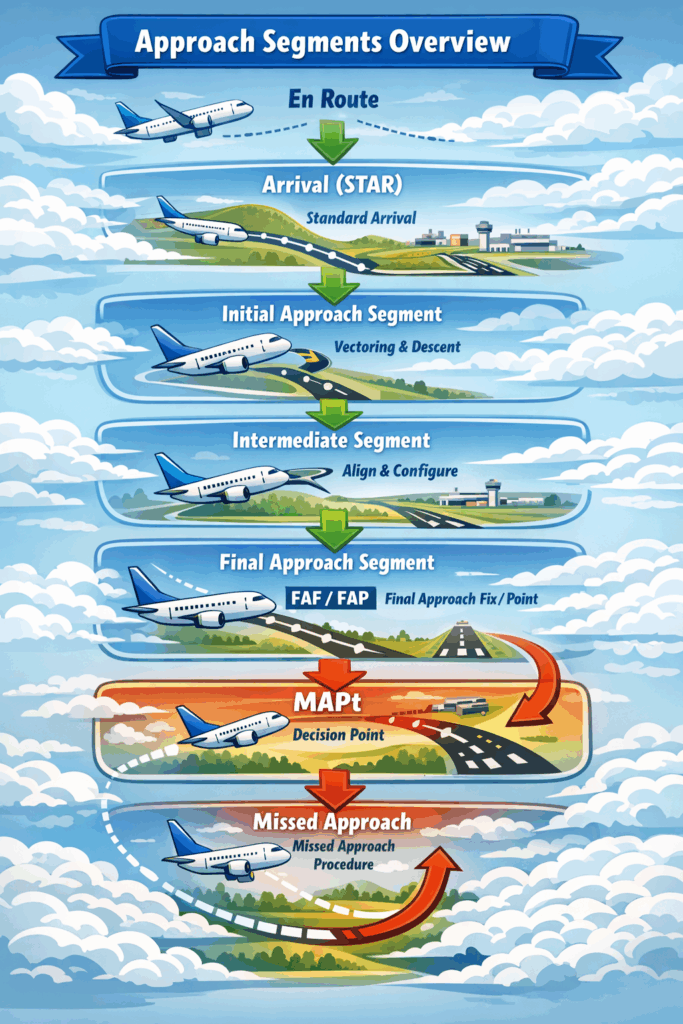
✈️ 1. Arrival Segment (STAR)
This is the transition from cruise (en route) to the start of the approach.
- Typically flown via a STAR (Standard Arrival Route) or RNAV transition
- Ends at the Initial Approach Fix (IAF)
- Aircraft is descending and being sequenced toward the airport
Visual idea
👉 Think of this like a highway exit ramp guiding aircraft from cruise altitude into the airport flow.
🧭 2. Initial Approach Segment (IAF → IF)
This segment starts at the IAF.
- Aircraft continues descending
- Gets aligned and positioned for the approach
- Often radar vectors are used at busy airports
- Ends at the Intermediate Fix (IF)
Visual idea
👉 This is where the aircraft is “getting organized” for landing—speed, direction, and descent are adjusted.
🛬 3. Intermediate Approach Segment (IF → FAF/FAP)
- Starts at the IF (aligned with runway centerline or within ~30°)
- Ends at:
- FAF (Final Approach Fix) → Non-precision approach
- FAP (Final Approach Point) → Precision approach
- Aircraft:
- Slows down
- Configures (flaps, gear prep)
- Keeps a shallow descent
💡 Note:
- IF is often not labeled on charts explicitly
- For RNP approaches, a ~10 NM waypoint may act as IAF/IF
Visual idea
👉 This is the “setup phase” before committing to landing.
🎯 4. Final Approach Segment (FAF/FAP → MAPt)
- Starts at FAF/FAP
- Ends at MAPt (Missed Approach Point)
- Aircraft is:
- Fully configured (gear down, landing flaps)
- Following a precise descent path
- Either:
- Visual contact → land
- No visual → go missed
Visual idea
👉 This is the most critical phase—you’re committed to landing unless conditions aren’t met.
🔄 5. Missed Approach Segment (MAPt onward)
- Starts at the MAPt
- Follow published missed approach procedure
- Ends at a defined point (e.g., altitude, fix, NDB, DME)
⚠️ Important:
- If go-around is initiated before MAPt, you usually:
- Continue to MAPt first
- Then follow missed approach path
- This ensures obstacle protection
Visual idea
👉 Think of this as a safe escape route built into every approach.