Definition and units (050.01.02.01)
Define ‘air temperature’ (050.01.02.01.01).
List the units of measurement of air temperature used in aviation meteorology (Celsius, Fahrenheit, Kelvin) (050.01.02.01.02). (Refer to Subject 050 10 01 01)
Vertical distribution of temperature (050.01.02.02)
Describe the mean vertical distribution of temperature up to FL 650 (050.01.02.02.01).
Mention the general causes of the cooling of the air in the troposphere with increasing altitude (050.01.02.02.02).
Calculate the temperature and temperature deviations (in relation to International Standard Atmosphere (ISA)) at specified levels (050.01.02.02.03).
Transfer of heat (050.01.02.03)
Explain how local cooling or warming processes result in transfer of heat (050.01.02.03.01).
Radiation
Describe radiation (050.01.02.03.02).
Radiation is the emission and transfer of energy in the form of rays or waves, like ultraviolet and infrared bands.
Describe solar radiation reaching the Earth (050.01.02.03.03).
Solar energy is created at the core of the sun and is emitted by electromagnetic short-wave radiation, mainly in the visible band and ultraviolet and infrared bands. Small amounts of energy are emitted in the radio, microwave, X-ray and gamma-ray bands.
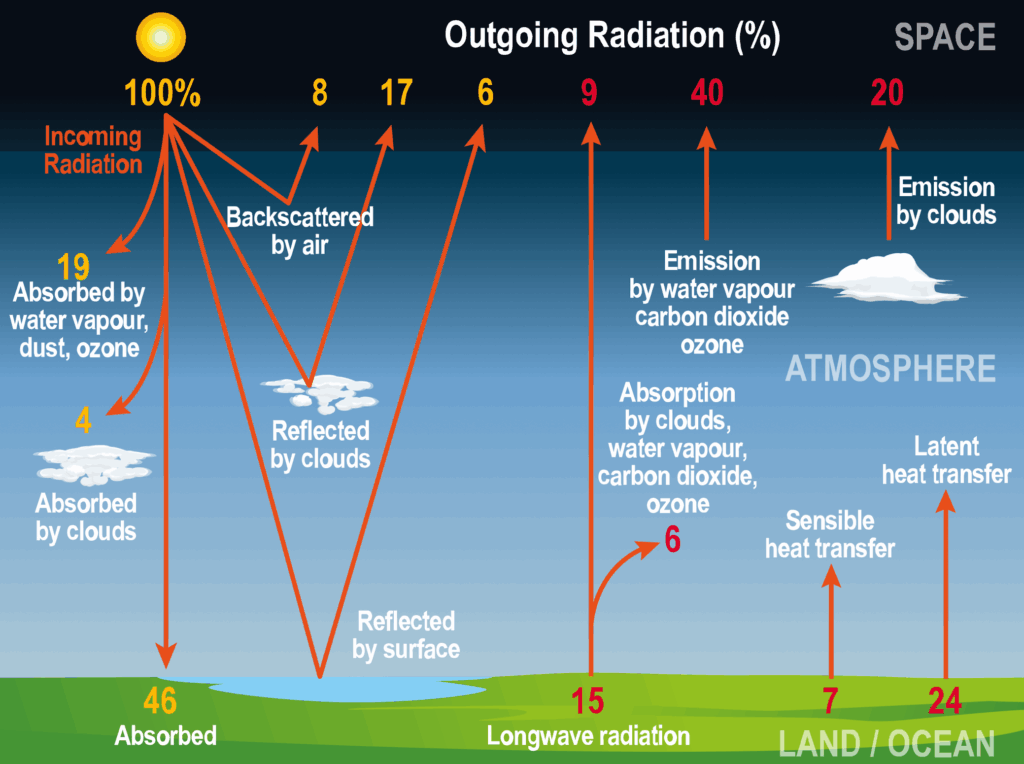
A lot of the energy emitted is diverted, scattered and reflected back into space and never reaches the Earth’s surface. The remaining solar energy that does passes the troposphere heats the Earth. And it is the Earth that then heats the troposphere.
Way to memorize that the Sun’s radiation is short-wave, Sun <-> Short (both include the letter “S”).
Describe the filtering effect of the atmosphere on solar radiation (050.01.02.03.04).
Let’s assume that by “filtering”, EASA means the overall reduction of the intensity of radiant energy from the sun.
A lot of the solar energy is diverted, scattered, and reflected by gasses high in the atmosphere. Some gasses in the atmosphere absorb solar energy before it reaches the ground:
- Ozone absorbs most ultraviolet (UV) radiation in the stratosphere;
- Water vapor (clouds) and CO2 absorb some infrared radiation;
Also tiny particles suspended in the atmosphere—called aerosols—reflect and scatter sunlight.
The intensity of the remaining radiant energy that reaches the surface of the Earth is dependent on its angle of arrival.
Describe terrestrial radiation (050.01.02.03.05).
As stated before, the Sun heats the Earth’s surface by radiation. The Earth heats the atmosphere by radiation, conduction and convection. Equal to the Sun, the Earth radiates energy, although at a much lower temperature than the Sun. Because of the lower temperature, radiation is at a much longer wave-length.
Explain how terrestrial radiation is absorbed by some components of the atmosphere (050.01.02.03.06).
Explain the effect of absorption and radiation in connection with clouds (050.01.02.03.07).
Radiation at this wavelength is absorbed by CO2, water vapor and clouds, heating the troposphere. Especially the lower troposphere, where clouds and water vapor are at a maximum.
Some of the absorbed energy is re-radiated (still long wave) and reflected back to the Earth, at a maximum rate in overcast conditions. Low-level clouds are generally thicker and have more water content, making them more effective at absorbing and emitting infrared radiation.
Low-level clouds are generally thicker and have more water content, making them more effective at absorbing and emitting infrared radiation.
Conduction
Explain the process of conduction (050.01.02.03.08).
Conduction is the process of energy (heat) transfer through direct contact. Warmer particles / molecules vibrate more rapidly and collide with neighboring particles, transferring some of their energy.
When a warm surface is in direct contact with a colder layer of air, the surface heats the layer of air. When a cold surface is in direct contact with a warmer layer of air, the air transfers energy to the surface and thereby cools down itself.
Explain the role of conduction in the cooling and warming of the atmosphere (050.01.02.03.09).
As air is not a very good conductor, the effect of conduction (in absence of any method to distribute the heat upwards), the effect of conduction will be limited to a very shallow layer at low level (i.e. still days and nights).
Convection
Explain the process of convection (050.01.02.03.10).
Name the situations in which convection occurs (050.01.02.03.11).
Convection is the upward / vertical movement of air. This can be forced convection – air forced over a range of mountains – and thermal convection – where the warm air has a lower density than its surroundings and therefore rises.
The rising air carries energy upward in two forms, ordinary heat energy and latent energy. In the case of latent energy, the air rises and cools, water vapor in the air is likely to condense to form cloud, releasing its latent heat of condensation.
Out of all the energy transferred from the surface to the troposphere, warm air convection accounts for 12% and latent heat convection accounts for 46% (remaining 42% is due to radiation).
The latent heat in water vapor transfers more energy than anything else.
Advection
Explain the process of advection (050.01.02.03.12).
Name the situations in which advection occurs (050.01.02.03.13).
Advection is the horizontal movement of air, wind. As advection only transfers heat horizontally it is not responsible for heating the troposphere, but is responsible for redistributing the energy within it.
Describe the transfer of heat by turbulence (050.01.02.03.14).
Describe the transfer of latent heat (050.01.02.03.15).